Learning CenterWhat is a mineral?The most common minerals on earthInformation for EducatorsMindat ArticlesThe ElementsThe Rock H. Currier Digital LibraryGeologic Time
搜索矿物的性质搜索矿物的化学Mineral Visual ExplorerAdvanced Locality Search随意显示任何一 种矿物Random Locality使用minID搜索邻近产地Search Articles搜索词汇表更多搜索选项
Mining Companies统计会员列表Mineral MuseumsClubs & Organizations矿物展及活动The Mindat目录表设备设置The Mineral QuizTime Machine
╳Discussions
💬 Home🔎 Search🚩 Flagged📅 LatestGroups
EducationOpen discussion area.Fakes & FraudsOpen discussion area.Field CollectingOpen discussion area.FossilsOpen discussion area.Gems and GemologyOpen discussion area.GeneralOpen discussion area.How to ContributeOpen discussion area.Identity HelpOpen discussion area.Improving Mindat.orgOpen discussion area.LocalitiesOpen discussion area.Lost and Stolen SpecimensOpen discussion area.MeteoritesOpen discussion area.Mineral ExchangesOpen discussion area.Mineral PhotographyOpen discussion area.Mineral ShowsOpen discussion area.Mineralogical ClassificationOpen discussion area.Mineralogy CourseOpen discussion area.MineralsOpen discussion area.Minerals and MuseumsOpen discussion area.PhotosOpen discussion area.Techniques for CollectorsOpen discussion area.The Rock H. Currier Digital LibraryOpen discussion area.Recent Images in Discussions


GeneralHelp with text on label

26th Dec 2025 20:31 UTCProdromos Nikolaidis Expert OP

Hi all and happy holidays
I’m cataloguing a Norwegian aquamarine specimen in my collection that came with an old label, parts of which I’m unable to read. Can anyone make out what the yellow highlighted text says?
Thanks in advance.


26th Dec 2025 21:12 UTCElmar Lackner Expert
Maybe: internal ??????, seen under xl transparency

26th Dec 2025 21:28 UTCBill Hamel 🌟
“internal flaws, seen under xl transparency”
26th Dec 2025 23:30 UTCGiles Peatfield
I like 'flaws' better than 'fluor'.
Giles
26th Dec 2025 21:27 UTCEd Clopton Expert
with internal fluor, seen under xl transparency
with internal fluor

26th Dec 2025 23:47 UTCJohn Christian
Please show us the specimen to see if it matches the translations.
27th Dec 2025 10:27 UTCYash Redkar
I see that as "with internal flaws, seen under xl transparency"
27th Dec 2025 20:28 UTCProdromos Nikolaidis Expert OP

Huge thanks to everyone—I was fairly confident that someone would be able to decipher what was written there.
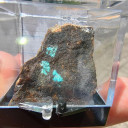
I now also believe that it reads: “internal flaws, seen under XL transparency”. For John’s request, and for the sake of consistency, here’s a photo of the specimen (size: 1.2 cm). I’m not sure why the previous owner chose to describe these features somewhat negatively as “flaws”, as from my perspective they are rather quite nice internal features which add more interest. Unless, of course, this is some sort of technical description from a gemological standpoint that I’m not familiar with.
In any case, thanks again for all the help.
28th Dec 2025 08:12 UTCYash Redkar
It is the flaws of a crystal that gives it its unique 'fingerprint' and personality! Which is why lab-grown gems won't ever work for me :)
28th Dec 2025 13:57 UTCProdromos Nikolaidis Expert OP
Yash, I fully align with your view. Although I’m not particularly into gems and tend to identify more with the "purists" of the mineral collecting world, there was one occasion when I bought a Brazilian cut emerald as a gift for my wife. From the selection of cut stones the dealer was showing me, my eye was immediately drawn to the largest one, which also displayed the strongest and most vibrant green color of the lot. Quite surprisingly, however, its price was not the highest—on the contrary, it was among the lowest.
I then examined it more closely with my hand lens and noticed some wonderful internal inclusions within the crystal. Later, I learned that gemologists commonly use the term "garden" (or "jardin") to describe these inclusions, often referred to as "natural imperfections", which can also help distinguish natural stones from synthetic ones. In the gem world, however, such inclusions are typically considered to downgrade the stone’s quality and, consequently, its value. To my eyes, though, these inclusions actually enhanced the crystal’s character, and I instinctively expected them to increase its price rather than lower it.
Apparently, the dealer sensed my interest and attraction toward that particular stone and subtly raised the price, claiming that its carat weight had not been measured correctly. Despite this, I still ended up buying it. That day, however, I learned a valuable lesson: had I downplayed the stone as being "flawed", I might not only have purchased it at a lower price, but perhaps even received an additional discount by appearing hesitant!
28th Dec 2025 18:31 UTCYash Redkar
Definitely does work by controlling emotions on the spot! I have also experienced this before. I am also like you, a mineral 'purist', rarely even getting anything that is slabbed or a cabochon, let alone a cut gemstone (the only cut gemstones in my collection being six blue Colombian sapphires I received as a gift) and I am absolutely a HUGE fan of inclusions like you! They never fail to amaze me, Prodromos. I have some rare inclusions inside common minerals, some examples of the rare inclusions being shattuckite, plancheite and julgoldite-(Fe3+), which absolutely always, always blows my mind away, somewhat like repeatedly experiencing Alan Grant's first sight of the sauropods of Jurassic Park.

27th Dec 2025 23:42 UTCVik Vanrusselt Expert
Some more info on the labels for anyone interested:
The printed label is that of Erik Huigen. He is a Dutch mineral specimen dealer who also regularly sells his specimens at mineral shows in Germany. Hence the label in German.
The handwritten text that has been added to Erik's label and also on the green sticker appears to be in Zelimir Gabelica's handwriting.
I have no idea, however, why Zelimir chose to use 3 different languages in his additions to Erik's label: besides English, "Novrège" is a misspelling of "Norvège", which is French for "Norway", and "Gent" is Dutch for "Ghent". Zelimir apparently also priced the specimen at 6 euros in the bottom right corner.
I have no idea, however, why Zelimir chose to use 3 different languages in his additions to Erik's label: besides English, "Novrège" is a misspelling of "Norvège", which is French for "Norway", and "Gent" is Dutch for "Ghent". Zelimir apparently also priced the specimen at 6 euros in the bottom right corner.
From this handwritten text, it looks like Zelimir acquired the specimen from Erik (or the other way around, depending on which of the two is the "original" label) at a mineral show in Ghent, Belgium. This most likely refers to the one organised by Nautilus VZW: https://nautilusgent.be/beurs/ (in Dutch).
I am from Belgium myself, and I have acquired several specimens from both Erik and Zelimir for my collection at the Belgian mineral shows they both attend. Therefore, I am familiar with both of their labelling styles, which is why I am fairly certain about the abovementioned information.
Happy New Year,
I am from Belgium myself, and I have acquired several specimens from both Erik and Zelimir for my collection at the Belgian mineral shows they both attend. Therefore, I am familiar with both of their labelling styles, which is why I am fairly certain about the abovementioned information.
Happy New Year,
Vik
28th Dec 2025 13:51 UTCProdromos Nikolaidis Expert OP
Vik, that’s excellent additional information—much appreciated.
You’re absolutely right, and indeed I acquired this specimen from Zelimir, who in turn obtained it from Erik. For the sake of posterity, and in case anyone happens to be researching Zelimir’s labels in the future, he told me that his cataloguing system follows a year of acquisition / specimen number format. For example, the aquamarine specimen discussed above is labeled 15/629, meaning it was specimen number 629 acquired in 2015.
It’s also worth noting that the label shown above appears to be more of a quick working note. Zelimir normally produces very elegant and carefully prepared labels for the specimens in his collection (see below).
28th Dec 2025 13:59 UTCProdromos Nikolaidis Expert OP

It seems that Zelimir’s handwriting is giving me some trouble, so I’d like to ask for some additional help in deciphering what’s written on these labels.
The top two images show Zelimir’s label (front and reverse) for a tourmaline specimen from "Lipowska, USSR", which he acquired in 1986. Presumably, the specimen itself was collected in 1952. However, I’m unable to make out what is written on the reverse side of his label (top-right frame). Perhaps Vik—since you seem quite familiar with Zelimir’s handwriting—you might be able to help?
The bottom two labels came with the specimen as well and appear to be older. They don’t seem to contain much additional information, but I’m also struggling to read the characters on the bottom-right label: specifically, the letters (or symbols) before "No 975" and the text following "880". Any insight on this would be greatly appreciated.
Additionally, it appears that "Lipowska" is not a locality currently listed on Mindat, or at least I wasn't able to find a good match even after using deep search and fuzzy match. Does anyone happen to know which place this refers to? A quick internet search didn’t yield anything obvious. I’m planning to do more in-depth research later, but if anyone already has information on this locality, I’d be very glad to hear it.

28th Dec 2025 20:55 UTCJohan Kjellman Expert
"Chez José Delferrière a Taoff"
880 Fr(ancs) apparently discounted down to 800
Can anybody confirm or elaborate on that?
28th Dec 2025 14:01 UTCProdromos Nikolaidis Expert OP

And here's a photo of this "Lipowska, USSR" tourmaline. Size is 9 mm.

28th Dec 2025 15:02 UTCTimothy Greenland
Might it be Lipovka in the volgograd oblast ?
28th Dec 2025 18:07 UTCO. Looker
28th Dec 2025 19:55 UTCProdromos Nikolaidis Expert OP
Thanks for the locality hint. loc-2798 indeed seems to be a good match, and the apparent "typo" in the name on the label is not surprising, given the locality’s various alternative spellings (Lipovka; Lipovskoe; Lipovskaya; Lipovaya).
28th Dec 2025 22:49 UTCVik Vanrusselt Expert
- "IDFN" (on the bottom right label) could be an abbreviation of "identification number"?
- 880 FR(ancs) (Belgian Franks, that is) could be correct. That's the equivalent of about 22 euros or 26 US dollars today. 800 Belgian Franks would be about 20 euros or 23.5 US dollars today (not counting indexation and/or inflation since 1986, when the specimen was acquired).
- 880 FR(ancs) (Belgian Franks, that is) could be correct. That's the equivalent of about 22 euros or 26 US dollars today. 800 Belgian Franks would be about 20 euros or 23.5 US dollars today (not counting indexation and/or inflation since 1986, when the specimen was acquired).
- "Taoff" (as Johan mentioned) could be "Tilff", a sub-municipality of the municipality of Esneux, in the Province of Liège, Belgium. Unfortunately, I don't know the name José Delferrière...
Vik
Vik
版权所有© mindat.org1993年至2026年,除了规定的地方。 Mindat.org全赖于全球数千个以上成员和支持者们的参与。
To cite: Ralph, J., Von Bargen, D., Martynov, P., Zhang, J., Que, X., Prabhu, A., Morrison, S. M., Li, W., Chen, W., & Ma, X. (2025). Mindat.org: The open access mineralogy database to accelerate data-intensive geoscience research. American Mineralogist, 110(6), 833–844. doi:10.2138/am-2024-9486.
隐私政策 - 条款和条款细则 - 联络我们 - Report a bug/vulnerability Current server date and time: 2026.6.3 23:49:00
To cite: Ralph, J., Von Bargen, D., Martynov, P., Zhang, J., Que, X., Prabhu, A., Morrison, S. M., Li, W., Chen, W., & Ma, X. (2025). Mindat.org: The open access mineralogy database to accelerate data-intensive geoscience research. American Mineralogist, 110(6), 833–844. doi:10.2138/am-2024-9486.
隐私政策 - 条款和条款细则 - 联络我们 - Report a bug/vulnerability Current server date and time: 2026.6.3 23:49:00